Poirot’s final gathering and exposure of the murderer
The Murder of Roger AckroydHercule Poirot’s final gathering and exposure of the murderer transforms the investigation of Roger Ackroyd’s murder into a public reconstruction of how the clues fit together. By arranging the room, summoning the people connected to the case, and presenting deductions in sequence, Poirot makes the gathering itself an instrument of proof: each explanation narrows the field until the pattern points to Dr. James Sheppard.
The Gathering as a Deliberate Scene
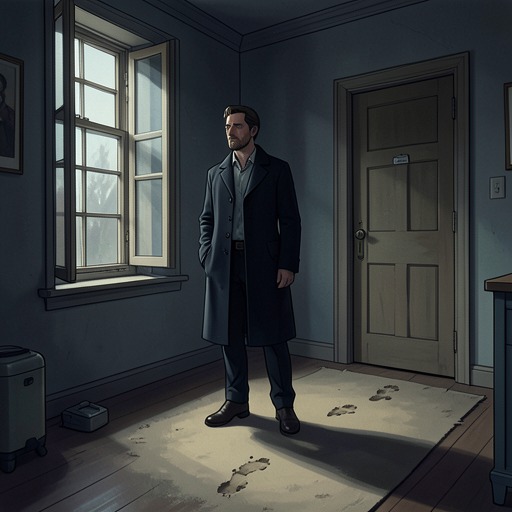
Poirot prepares the room before the guests arrive, moving chairs and a lamp and straightening the mats. He adjusts the lighting so that the chairs where the party will sit are clearly illuminated, while the end of the room where he expects to sit remains dim. The contrast places the assembled group in view and keeps the detective at the less conspicuous end of the scene. When the bell sounds, Poirot says that the guests have arrived and that everything is ready.
The party from Fernly Park files in, including Mrs. Ackroyd, Flora Ackroyd, Hector Blunt, and Geoffrey Raymond. Poirot greets them, but the gathering soon takes on a more formal character. He reads a list of those present: Mrs. Ackroyd, Flora, Blunt, Raymond, Mrs. Ralph Paton, John Parker, and Elizabeth Russell. The list makes the assembly feel less like a visit than a defined inquiry, and Raymond’s immediate question about its meaning registers the uncertainty Poirot has created.
Poirot tells Mrs. Ackroyd that she cannot leave until she has heard what he has to say. The instruction establishes his control over the meeting and its order of disclosure. The party’s unease, which passes across the faces grouped before him, anticipates his description of the gathering as a trap that has closed. The effect is not produced by force or spectacle, but by the knowledge that everyone present is being placed inside the same explanation.
Reconstructing the Summerhouse Meetings
Poirot begins by retracing the investigation from its beginning. When Flora asked him to investigate, he went to Fernly Park with Dr. Sheppard, examined the terrace footprints, and followed Inspector Raglan along the path toward the drive. A summerhouse caught his attention. Searching it, he found a scrap of starched cambric and an empty goose quill. The cambric suggested a maid’s apron; the quill suggested someone who used drugs.
The first apparent explanation connected Ursula Bourne, the parlour maid, with the stranger Dr. Sheppard had encountered near the gate. Ursula said she had been in her bedroom from half past nine until ten, but Poirot considered that she might instead have gone to the summerhouse to meet someone. The stranger’s American accent and the goose quill seemed to support the possibility that he had come to meet her. Poirot then tests that account against the times: Ursula could not have reached the summerhouse before half past nine, while the stranger must have arrived by a few minutes past nine. Rather than forcing the two accounts together, Poirot considers that the summerhouse hosted two separate meetings.
That possibility brings Miss Russell into the reconstruction. She had visited Dr. Sheppard that morning and shown interest in remedies for drug addiction, making her a more likely intended contact for the stranger than Ursula. Poirot then turns to Ursula’s own appointment. A wedding ring bearing the inscription “From R.” and a date, together with the report that Ralph Paton had been seen on the path to the summerhouse at twenty-five minutes past nine, links Ursula to Ralph. News of a conversation between Ralph and an unknown girl in the wood that afternoon adds another piece. The secret marriage, the engagement announced on the day of the murder, the stormy conversation, and the meeting that night form a connected sequence rather than unrelated suspicions.
This reconstruction changes the significance of Ralph’s apparent motive. Because he was in the summerhouse with his wife, Poirot concludes that he could not have been with Roger in the study at half past nine. Charles Kent, the stranger, had already left. Poirot therefore asks whether anyone was in the study with Roger at that time at all. The question overturns the assumption that the murder required a visitor to be present and redirects attention from identifying a supposed companion to testing the premise behind the inquiry.
Testing the Telephone Call and the Missing Machine
Poirot explains that two facts and a discrepancy in time first drew his attention: the telephone call and the timing surrounding it. If Ralph had been the murderer, Poirot argues, the call would have been meaningless. He consequently ruled Ralph out, while maintaining that the criminal had to be among the people present on the fatal evening. Since the call could not have been sent by anyone inside the house, Poirot provisionally inferred an accomplice.
To understand the call, Poirot asks what it achieved. It caused the murder to be discovered that night rather than probably the following morning. That consequence gives the call a practical role in the crime’s timing and directs attention toward whoever could benefit from an earlier discovery. Poirot does not treat the call as an isolated oddity: its meaning depends on the sequence it produced and the conditions it created at the house.
The report that a representative of the Dictaphone Company had visited Roger leads Poirot to consider whether Roger used a Dictaphone on the night of his death. The important difficulty is that no machine was found among Roger’s effects. If an object had been taken from the table, Poirot reasons, it could have been the Dictaphone. But the machine was too bulky to slip casually into a pocket, so its removal implies that the person who took it had a suitable receptacle.
The timing and practical details now begin to converge. Poirot imagines a murderer who was at the scene immediately after the crime, but who might not have been there had the murder remained undiscovered until morning. The person must also have been able to carry away a Dictaphone in something large enough to contain it. In this way the missing machine becomes more than an absent object: its size and removal help define the circumstances and equipment of the person Poirot is seeking.
The Dagger, the Receptacle, and the Accusation
Poirot adds the murder dagger to the chain of opportunity. The murderer must have been able to take it from the silver table before Flora arrived. Poirot emphasizes that Flora was certain the dagger had not been on the table when she examined it. Her observation supplies a limit: whoever removed the weapon had the opportunity to act before that examination, rather than merely being someone who could have entered the house at any time.
In his recapitulation, Poirot combines the requirements rather than relying on a single clue. The culprit had been at the Three Boars earlier that day, knew Roger well enough to know he had bought a Dictaphone, had a mechanical turn of mind, could take the dagger before Flora’s inspection, and carried a receptacle such as a black bag that could conceal the machine. The person also had a few minutes alone in the study after the crime was discovered, while Parker telephoned the police. Each condition narrows the possibilities by joining knowledge, opportunity, and the practical means of removing the Dictaphone.
Poirot names Dr. James Sheppard as the person to whom this combined description points. The accusation is presented as the endpoint of a staged argument, not as an unsupported declaration: the earlier clues have been rearranged into a set of conditions that converge on him. The gathering’s social tension therefore becomes the consequence of an evidentiary trap. Poirot’s controlled sequence of questions and disclosures turns the assembled witnesses into an audience for the conclusion, while the concrete objects—the ring, goose quill, dagger, and missing Dictaphone—make the case legible piece by piece.
Narrative Function and Significance
The gathering gives the investigation a retrospective structure. Poirot invites those present to follow the route he took through the evidence, beginning with the telephone call and the discrepancy in time, then revisiting the summerhouse, the Dictaphone, and the dagger. The audience receives not simply a final answer but a demonstration of how initially competing explanations can be tested against chronology and physical circumstances.
The scene also turns ordinary acts of speech into instruments of control. Poirot’s list establishes who is inside the room; his instruction that Mrs. Ackroyd must stay fixes the terms of the meeting; and his step-by-step account determines the order in which the group encounters the evidence. The final naming of Dr. Sheppard completes that progression from summons to explanation to accusation. The decisive significance of the event lies in this conversion of a roomful of suspects and witnesses into a single, ordered account of the crime—and in the way that account makes the investigating doctor its conclusion.